Last updated on July 7, 2026 6:36 am
Former active-duty U.S. Marine Brandon Demeter, who previously discussed the challenges of lighting design for spacecraft launchpads and hangars, recently explored his work as a lighting sales and specifications consultant for Alcon Lighting.
Question: How long have you worked for Alcon Lighting?
Brandon: Just over three years—three years and a few months.
Question: What’s your favorite part of coming to work every day?
Brandron: Lighting—I appreciate lighting, something I enjoy. There’s a great deal of diversity in experiences. So, the fire never dims, never needs to be stoked. It’s stoked daily with the complexities of different applications or functions people are looking for and [I like] finding that right light, envisioning the design, how it’s gonna look, what [the customer is] trying to pull off, and giving the customer an education so they’re better able to choose and decide. I enjoy hearing the customer get excited and, sometimes, getting pictures back from customers like, ‘hey, this lighting looks great,’ and ‘here are some pictures, love it.’ I’m driven more by that than anything. I like having the opportunity to help people come up with their lighting—with great lighting. Watching the customer go with the right decision—that and, after the installation, the customer enjoying lighting doing exactly what they need. That’s my biggest drive.
Question: Did that happen today?
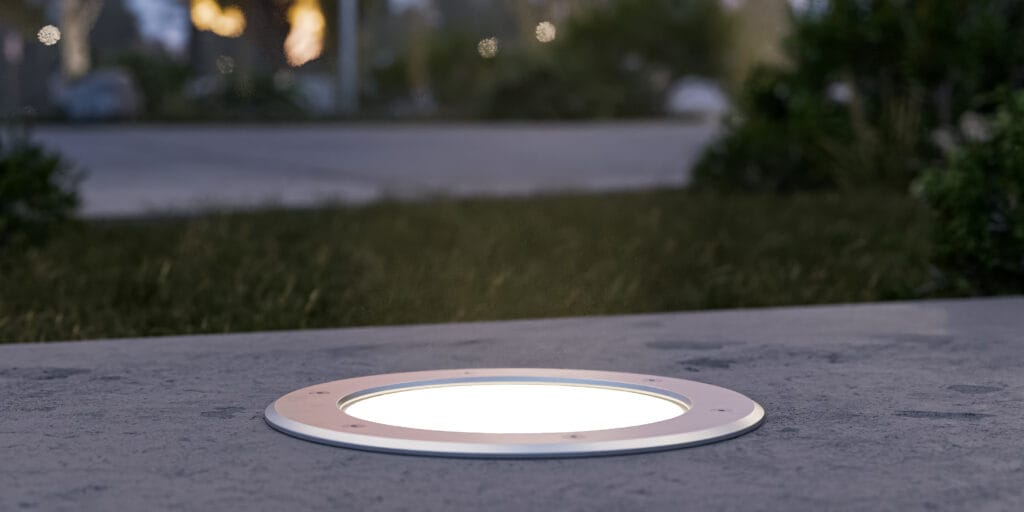
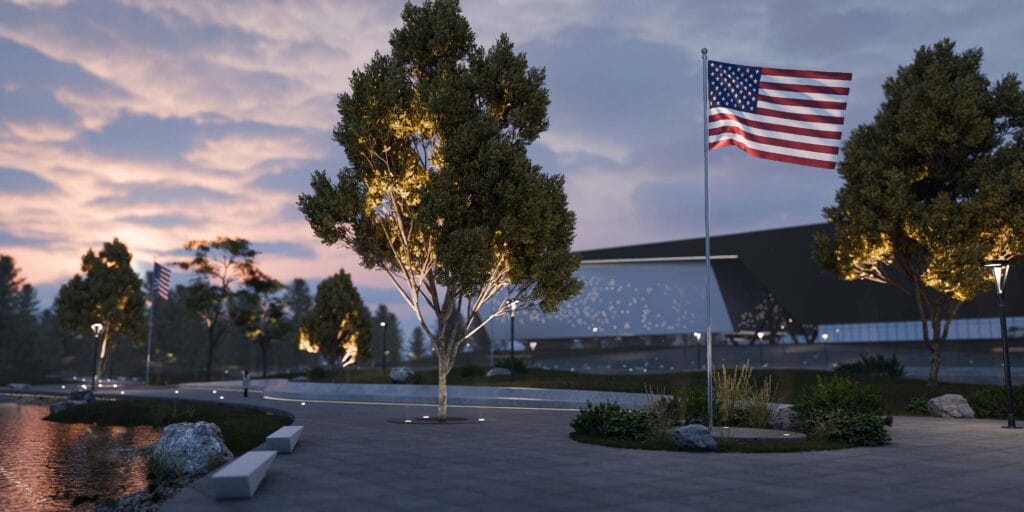
Brandon: Not yet. Though recently, there was a customer who wanted to light the flag, trying to figure out options. They didn’t wanna put anything above ground, so you know we kind of talked it through and, a couple of weeks ago, found the right fixture or what we thought could be the right one. I got a call from him this morning just to verify the installation and voltage. Hearing the excitement in his voice, I know he’s about to get it done with the electrical contractor. The goal was to illuminate the American flag, which is at every post office, and, at night, proper lighting is part of the flag code. It is such an important goal and mission, and he was able to do that with Alcon Lighting’s in-ground lighting. We overcame some of the unknowns by using the 9102, which is adjustable. And they’re on 240 volts, which requires them to have something that is, you know, over 120 volts, less than 277, so universal 120 to 277. It basically fit the bill perfectly.
Question: Were you able to make certain suggestions that guided him in the right direction to make better choices to give him what he needed?
Brandon: I have to give credit to him because he came with ideas. It’s a matter of listening and understanding what the need is, then finding the product that fits that need in both function and form. It was important for him to make sure that the light was weather-resistant and not be able to get run over like their previous fixtures, which is why we went with in-ground lighting. This customer works with a development company—they refurbish and reuse properties—and they were looking to use linear style fixtures. There was a lot of back-and-forth, looking at different available fixtures. We came up with a color-changing light with separate switching and controls for the uplight and downlight. It was kind of outside the box. I’m super excited to see how it turns out. I think it’s gonna look great.
Question: Let’s explore similarities and differences. What’s similar about your approach to lighting a retail store, for example, or a commercial property or building, such as a post office or an office building, to lighting for NASA?
Brandon: If it has to do with the space industry, there’s more consideration of the technicality of what you’re doing, and specifications can be rigid because they’re focused on the function of light and not as much form. They have to make sure they have appropriate footcandles for the work they’re doing—the detailed work they’re doing—in case anything happens to drop on the floor, so they can’t really have shadowing. There are specific criteria that have to be met, and within that, things can hinder you from using what you would normally use. You might go to a high-bay fixture or use a vapor type of lighting, then all of a sudden find out that a particular area is gonna have high vibration. So then it’s got to be rated to a certain amount of vibration, or they can’t do that particular fixture because the vapor type must also be explosion-proof. There’s a lot more function-driven design when it comes to something in the space industry.
With retail and commercial lighting, you want to properly light a work area or light merchandise, but you also want it to be aesthetically pleasing. You might get into lighting on a particular wall with warmer light in the center. Maybe use track lighting to have a decorative head on it or downlighting in a linear recess instead of just roughers—so there’s more of function and form. They’re both exciting in their own aspects. With space industry lights, you’re trying to meet a technical spec and very likely to learn technical stuff in doing it. With the other, you’re trying to hit presentation while also making it look pleasing so people spend more time in the store or enjoy working at the office.
Question: What are the similarities?
Brandon: Everything needs a certain amount of light, so with both you’ll need to find out what the light level is based on the intent of the customer.
Question: Is there a type of lighting you think is underestimated?
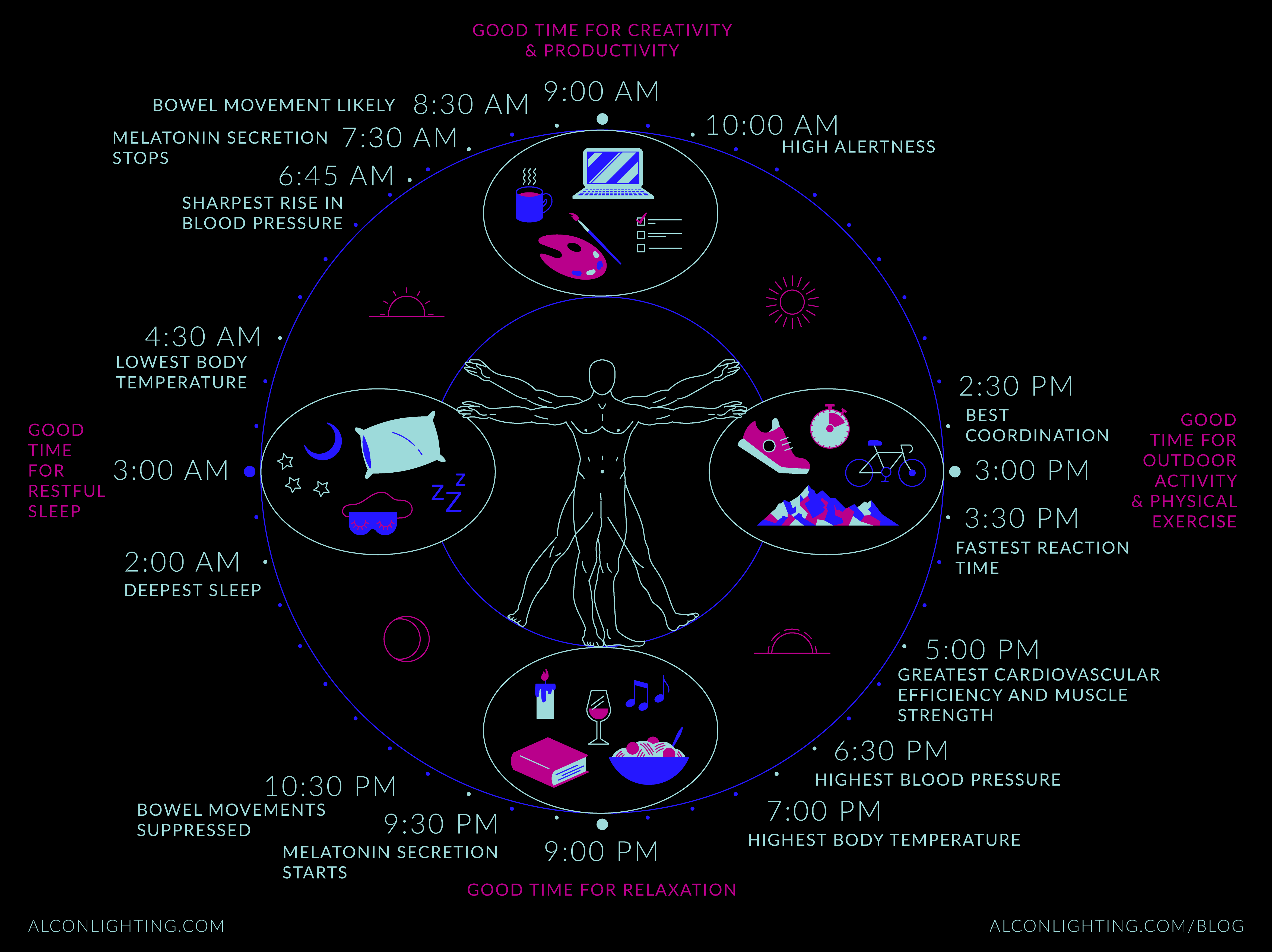
Brandon: Circadian rhythm-based, color-tuning adjustable lighting. I don’t think people realize the potential. Put it in a lobby area and give it that warm color temperature, nice and inviting, relaxing—you know what I’m saying?—and take that same fixture and put it in the hallway or the kitchen and give it that cool, 4000K bright white type light. It’s gonna be the same amount of light. It’s just the way the light looks that helps define the area. Once I learned about the science of the circadian rhythm—I’ve done projects in the past on the lighting and control side—I realize how helpful it is to the brain. To have that natural change of color temperature through the day into the night—it’s almost addictive. I have pretty much every lamp in my house on circadian rhythm because it helps the brain in ways we might not be immediately conscious of, but it’s scientifically proven and documented.
Question: How did you learn that?
Brandon: Years ago, I had to do this project for the Veterans Administration in Florida at a wellness center. And they had already done the research and said, we would like to do something that follows the circadian rhythm. And so it was a custom design—LED fabric, huge panels—but, within the programming, we were able to basically track the color temperature through the day and have the fixtures match. And what really struck me was that they were saying that Veterans [may be] impatient—not going for extended periods of time—and the goal of it was to help their brain cycle to get kind of normalized because of the lack of circadian rhythm [Veterans] would get from being outside.
And that’s what got me interested, where I started kind of looking more at it like, that’s fascinating. I had seen these commercials on TV about a guy who was blind, and he was talking about circadian rhythm and how it messed up his sleep cycle. They were advertising treatment. So, those things just kind of started making sense. And I had previously done a job in the Virgin Islands for the lighting and controls programming at a dolphin research center. The doctor in charge of the place was into [studying] circadian rhythm as well, making sure the lights in different areas were the right color temperature and on for the right length of time. There’s a lot of science in it that I didn’t understand. But it just all kind of lined up, and it was one of those moments where I thought: this is really important. You never think about it, but then once you do and see it, you realize you’ve spent a majority of the day inside sitting in front of a computer—and maybe I would benefit from better lighting.
Question: Now, bringing it back to Alcon Lighting, there have been several articles on Insights and Language of Lighting about circadian rhythm lighting. Do you read and distribute those articles as reference points for your customers to educate them, to guide them in the advantages of circadian rhythm lighting?
Brandon: Absolutely, I bring the issues up as soon as they show interest. We’ve got articles about circadian rhythm lighting, which can educate them about the need for some type of control.
Question: Among the lights you sell, which is your bestselling lighting?
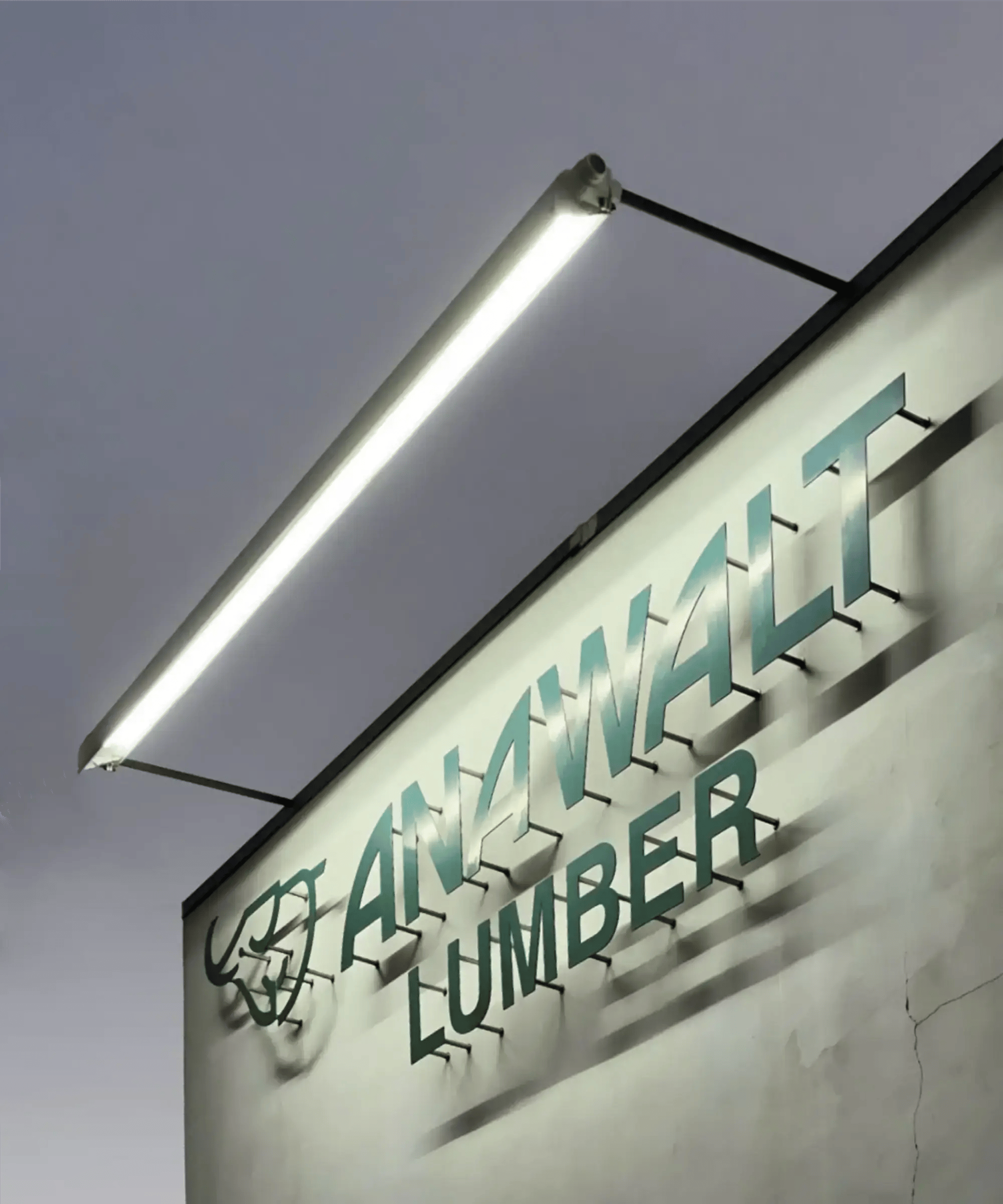
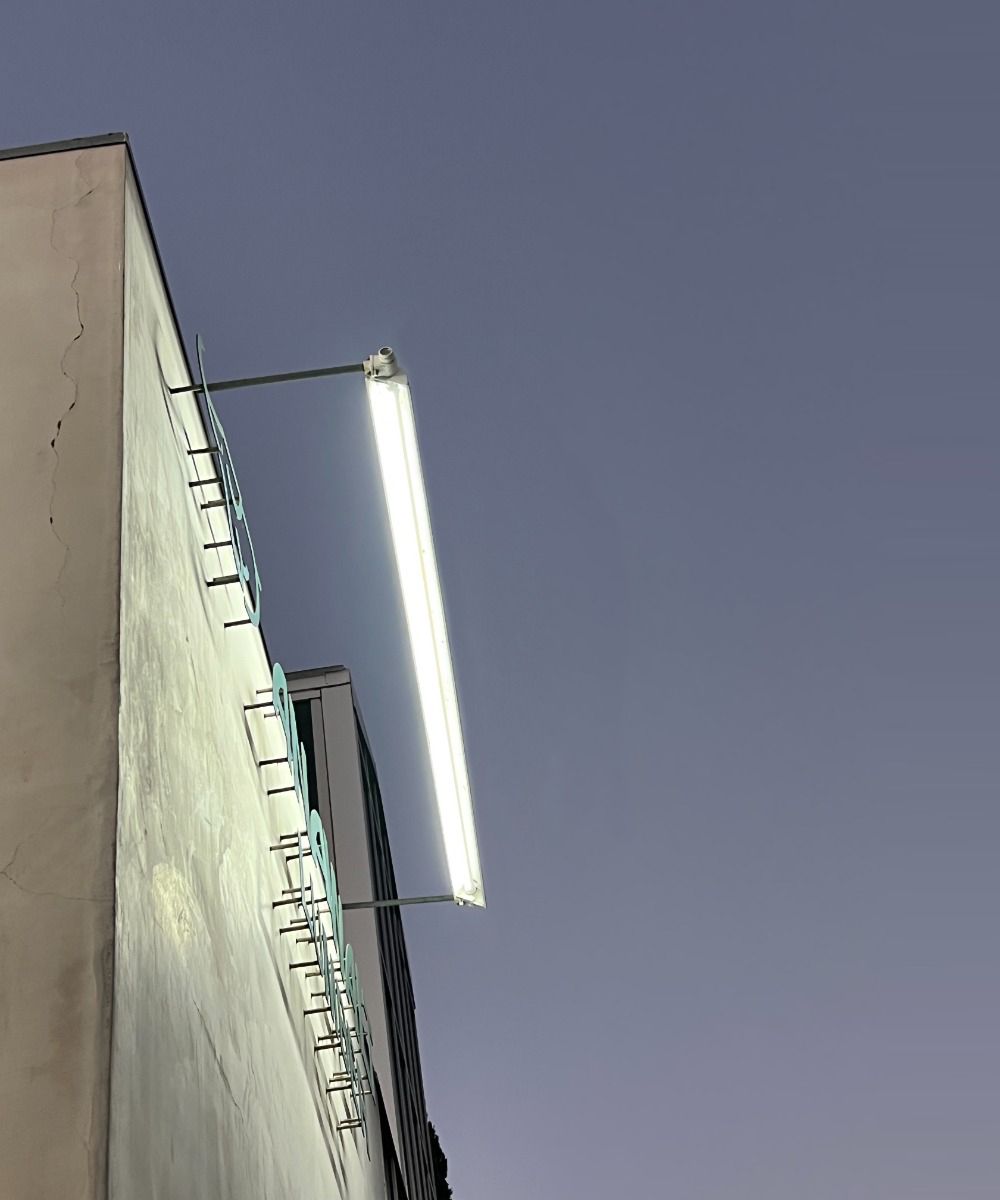
Brandon: The 31029 sign light.
Question: What’s the type of lighting?
Brandon: The 31029. It’s a linear LED.
Question: Why do you think they’re popular?
Brandon: It’s got a good look. It’s got a good amount of lumens. It’s adjustable for contractors who aren’t scared. They see that they get to mount it on their own arms—get their own pipe cut and threads—so they like that versus having a fixed arm length, because with signs, they’re not all gonna be the same width and height. So they have to kind of pull it out or bring it in, and [this light] makes it easier with the rotation. Aside from that, our linear line—it’s 1211, 2022, 25—and then the 14143, the trimless.
Question: Was there a particular sale or customer you remember getting you across the finish line or helping you propel you farther faster?
Brandon: One customer who stands out to me is Robert. He was my first sale in lighting—which was years ago—and we’ve caught up since I’ve been at Alcon Lighting. We still do business together to this day.
Question: What makes Alcon Lighting different from the competition?
Brandon: We have a huge, diverse offering. Within that, we have available resources—we can go outside even that box, like the XMO fixtures, you know, the O was pretty straightforward. The X however, being able to go outside the box and work with the production team and be like, hey, you know, we don’t want it to just have separate control—we want it to have separate switching. There’s a lot that goes into [Alcon Lighting’s product line]. People take RGBW for granted, but every section’s got to have its own decoder or receiver to get them all working in sync. Also, the team—being able to get with [the company’s owners] or our sales manager, Bob, or the production team who get stuff done—that’s not your normal, run-of-the-mill [lighting company], you know? We offer very specialized type fixtures, so we’re able to offer the customer a customized sale process.
Question: And what is the differentiating factor for that? Why is that the case? Is it the training? Is it the resources? Is it the hierarchy of the company? Is it the size, the smallness of the company? Are we more agile? The sales meetings or internal company dialogue—what’s underlying Alcon Lighting’s ability to excel?
Brandon: [The capacity] to be able to ask questions, to step outside a paradigm, so that when you send in something off the wall, [the company’s owners say] OK, let’s look at that, let’s get with engineering to see if that can be done. It’s a type of flexibility that’s sometimes very hard to find because they have that [hard] line. Alcon Lighting offers options. You ask to deviate, and [most competitors are] like: product deviation?? You’ve got to order 200. Here, we cater to the individual.
Question: You’re saying the can-do spirit of let’s get this done for the customer—a dedication or loyalty to the customer that we can do it—that we can try or endeavor to make what they want or customize an order, this individualization, is what sets Alcon Lighting apart?
Brandon: Yes. It’s like Michael Jordan or Wayne Gretzky once said: you miss 100 percent of the shots you don’t take. We’re competitive, yeah, but we’re not gonna just say no; we’re gonna find out what your options are and try to give you what it is you want; we’re gonna look for those options; we’re not gonna ever just say no [for the sake of following orders or duty to a dogmatic rule]. I’ve got a project I’m working on now—and I can’t get too deep into it—and they’re very specialized fixtures that are doing something totally out of the box, which, in the end, could end up being something groundbreaking.
Question: What is your most consistent customer compliment, Brandon?
Brandon: My knowledge. Customers tell me they appreciate the level of knowledge I have about lighting and controls.
Question: When they compliment you, Brandon, is it that they’re just complimenting you for your knowledge, your wealth of knowledge, or do they compliment you on your ability to communicate your knowledge?
Brandon: My ability to communicate my knowledge so that they have an understanding of what they’re getting or what they’re deciding on.
Question: And what’s your favorite customer compliment?
Brandon: The same, helping the [individual] understand. Sometimes people think they’re getting something that they’re not. And when I can educate them, I can cut off [problems] in the beginning or, in some cases, stoke them into thinking of doing more because it can go either way. Sometimes they’re like, ‘Oh wow, I’m so glad you told me…’ or I’ll end up hearing from that person in the future because they’re coming to me with another job. They’re like, ‘Hey, you helped me with this or so and so said you helped them with that—and now we need this. Can you help with that?’ I try to be the person I want to do business with.
Question: What was your first impression of David Hakimi?
Brandon: David seemed like a cool guy who was all about the work, but also very approachable. He came off as part of the team—a leader but part of the team—and he [struck me] as someone I would hang out with, go surfing with, maybe play soccer with. He’s way better than I am.
Question: How do you know that?
Brandon: He plays or used to play in an adult soccer league. And I don’t think I could hang with an adult league at this point. I can coach soccer—I help coach my son’s soccer team and stuff like that—but I bet David is better. I have no doubt.
Question: What was your first impression of Jake Hakimi?
Brandon: Jake is all about the business of lighting, but he’s also very in touch as a human. You can just feel his compassion, empathy and understanding. Jake and David Hakimi absolutely work on a human scale—Alcon Lighting is a human-centric company—which is rare to find in business these days. What resonates most with me is the way I like to work—like I was saying earlier—where I’m able to show the customer that I don’t care if you don’t get this or that product because [what matters] is the truth. When you give someone the truth, they’re gonna come back to you for the truth—because it’s more important that you do the right thing and that people are happy than it is to make the sale. Knowing I’m doing the right thing the right way and not thinking only of the numbers—that the [individual] is paramount—I wouldn’t trade that for the world.
Question: What was your background before you were hired at Alcon Lighting?
Brandon: Controls, network design and programming. That’s basically my background; I have a technical background. I was given the opportunity that if I wanted to learn lighting and put my technical background to work in the lighting world, I would be able to go through and get all the lighting education I needed. I did that for years. I ended up falling in love with lighting. When I had the opportunity [to work for] Alcon Lighting, it fit perfectly in every way. I jumped on, and I haven’t looked back.
Question: Does your military experience help during sales?
Brandon: It probably helps more with regimenting the discipline and organizational behavior. Beyond the military [part] of being a Marine, we never stop, and we never give up. That extra layer has helped me many, many times, especially [during] lockdown, volatility in the market and [coping with] the unexpected. That can get you down, and you’re trudging through. The [United States] Marine Corps undoubtedly showed me that I can do whatever I put my mind to as long as I don’t stop.
Question: How has your background in military intelligence and technology specifically equipped you to handle complex lighting projects for NASA, the compound at Cape Canaveral and defense contractors such as Lockheed?
Brandon: For control and type of design. Lighting can be nominal, but controls are very specific, so having that background and understanding makes it easier for me to [examine] a job. And having those check marks in my head helps me [judge what] needs to be terminated, [whether there are] too many devices on the network or that run is too long or knowing we need a booster here—all that stuff kind of pops because I’ve been used to pretty technical stuff since I was 17 or 18 years old. It definitely helps. Dealing with signals and frequencies—the spectrum of frequencies—having that base knowledge, as I learned lighting, made it very easy to start understanding.
For example, there’s a difference between audible frequency and visible frequency. Or turtle-friendly wildlife lighting. When that first came up to me, I wasn’t dumbfounded with the nanometers they were talking about; I was able to translate the frequency and go, ‘oh, OK, so that means it’s got to be in this part of the spectrum…’ So that crossover, being able to relate and in some instances compare, was incredibly beneficial for me. Have you ever wondered why a turtle can’t see 600 nanometers? They can’t differentiate, you know, which made me start thinking about my dog and, you know, like, oh, OK, so you can’t see the red of that red light, but he can see the blue. Why is that? All that good stuff.
Question: What sparked your initial interest in signals?
Brandon: I took that test—the Defense Language Aptitude Battery. I left thinking I failed…but they said that [I tested in] the top 20 percent of scores. The whole way back, I thought I had failed, and I was gonna be a military police officer until I was 19 because you couldn’t be an MP until you’re 19 in the Marine Corps, so I was gonna wait. And I ended up passing. That’s when they said, OK, so definitely yes to [me working in] military intelligence—and signals intelligence from electronic warfare is the route. I was like, yeah, absolutely. I didn’t know anything about it. I just knew that you know having a dad who’s an electrical engineer—smart and savvy about that stuff, fixing TVs for people in the neighborhood, that type of guy—it seemed interesting to me, and it was once I went through the training in school. I learned a much greater depth of knowledge about it. It’s always been fascinating to me.
Question: Which trends or innovations do you foresee having a real impact on lighting design and application in the near future?
Brandon: Circadian rhythm and probably more code-driven, presence lighting, whether it’s occupancy or vacancy. I see that moving to most places, probably even into apartments and homes, where you know the room is lit and you don’t have to do anything, it turns off after you leave. I see automation definitely being the thing.
Question: Why and what’s driving that?
Brandon: Two things. We’re unfortunately in a culture of instant gratification. Also, the main push for that comes down to code. And a lot of code is pushing for that. It starts commercial and ends up trickling down because the reality is that LEDs changed the lighting industry for the best. There’s less load, there’s less conduction of heat, which makes air conditioners run less. Incandescent fixtures put off a lot of heat—people have experienced rolling blackouts where so much [electricity] is being used that [the government] cuts people’s power. So there’s multiple levels of saving—and, as LED continues to take over, it’s beneficial.
Question: For the lighting designer or the engineer who’s motivated to work in aerospace, what knowledge or practical experience do you recommend to have for entering and succeeding in that field of endeavor?
Brandon: Most important, they’ll need to understand the light levels they need to perform the job that they have to do—the light levels to pull off the job. You need to not only understand the fixture and its capability as far as getting that light level, but also you have to understand that it’s not just [a given] space—the environment—the [location of the] site—is gonna play a huge role in determining the production and engineering behind the fixture. You’ll need to know that more in aerospace.
Question: What have you learned from your Alcon Lighting sales colleagues?
Brandon: Perris Weber is always hungry. I don’t know how else to put that—he’s always in the [arena]. Andre Kibbe is all about process. He’s logical, definitely process-driven. Jennifer’s got a willingness to try to work on stuff—she’s got the willingness to take on stuff and try to make something out of it. Stephanie has a vast knowledge of operations. She’s always very calm and steady as she goes through her work
Question: What do you enjoy most about lighting?
Brandon: Helping to create the environment—to light your environment.
Question: What’s your favorite enterprise—that, when the deal was done, when the sale was closed, knowing you helped that company make money with lighting?
Brandon: Just knowing that I helped them make money—to be a more commercially successful company because of their lighting, to get more customers, to make people happier, to make money—is its own reward. The flagship Adidas store in LA has three linear color-changing fixtures to match the three stripes on Adidas. I think it’s like a really cool design. Also, we did a wall-wash linear fixture for Spencer Gifts locations, and it’s quirky in the stores. Milana Laser Hair Removal buys lighting for its new locations. I’ve been working on a design for some linear color-changing on the exterior of Raising Cain’s [Fried Chicken] locations.